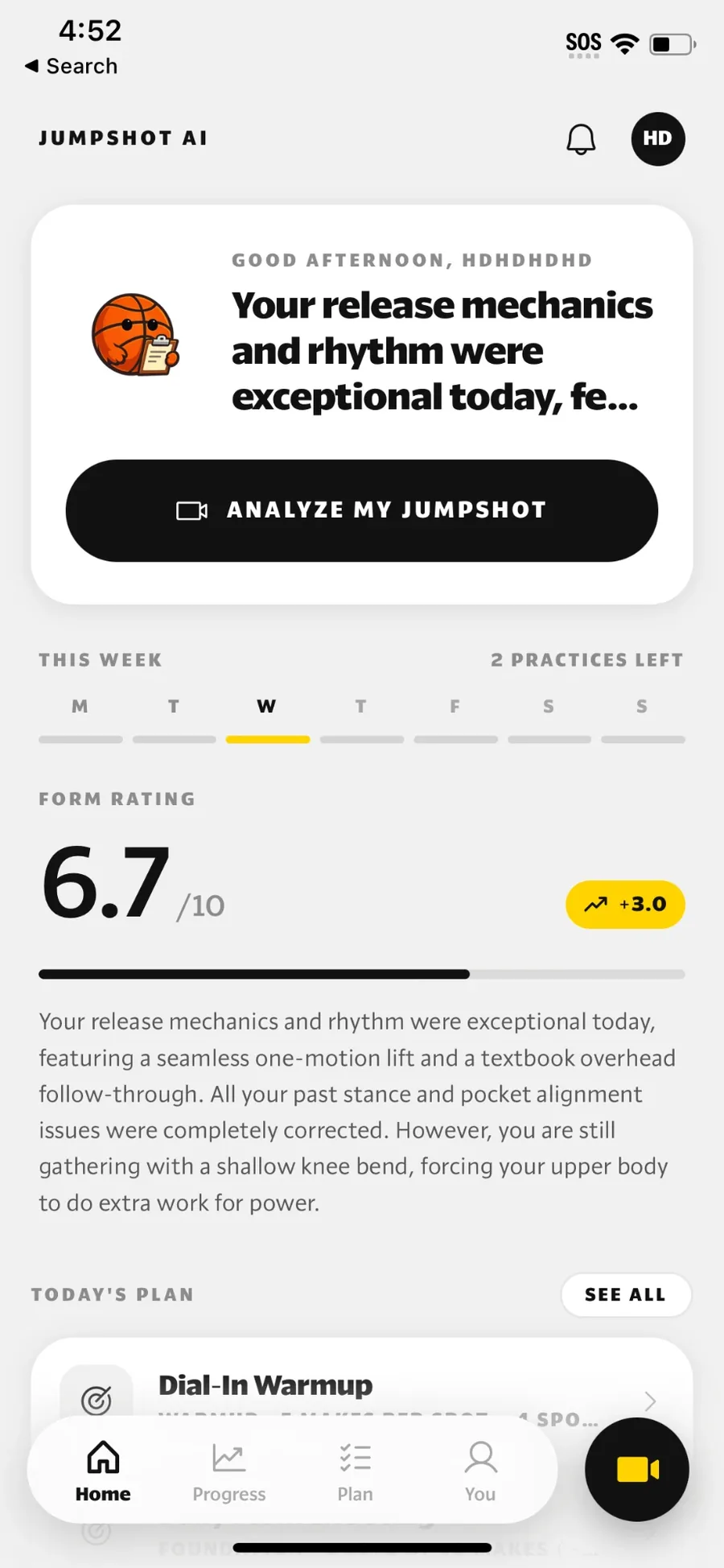
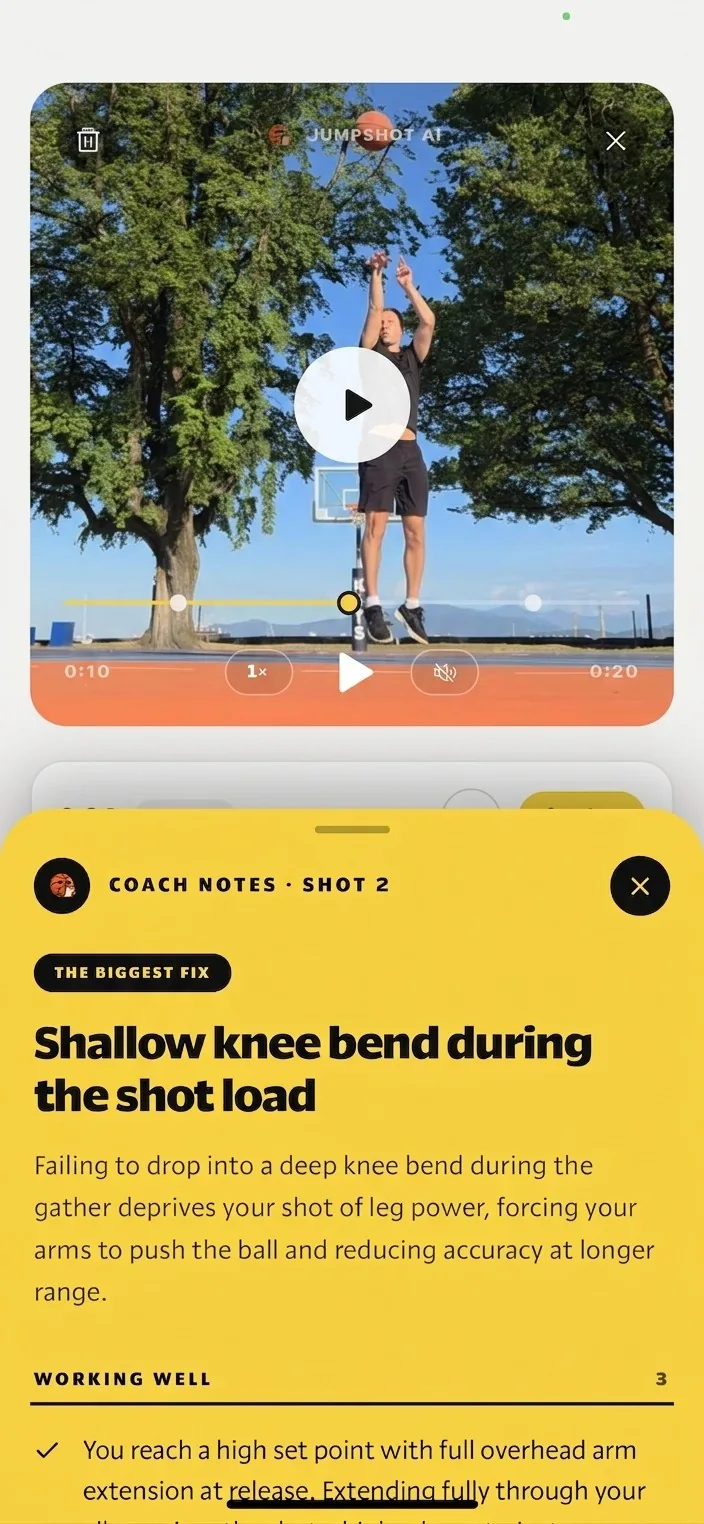
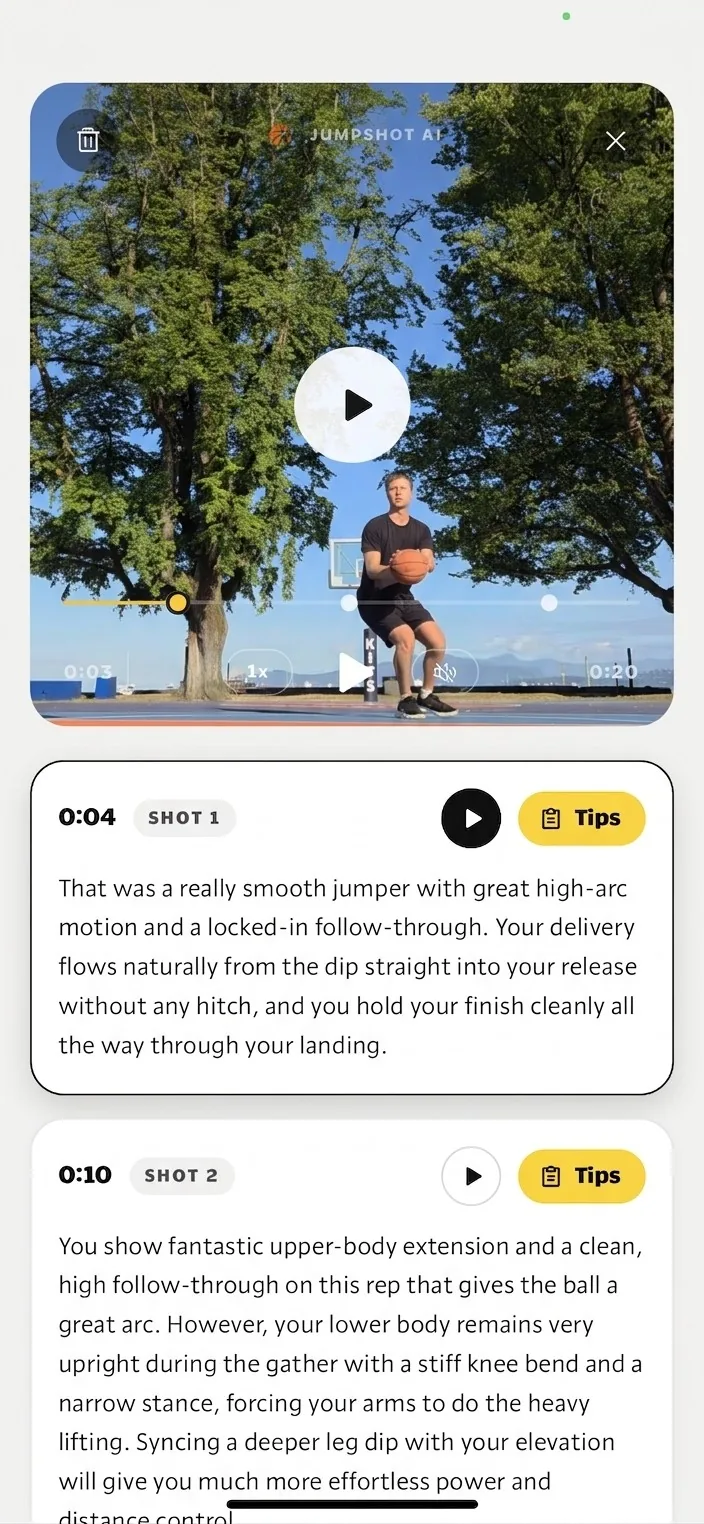
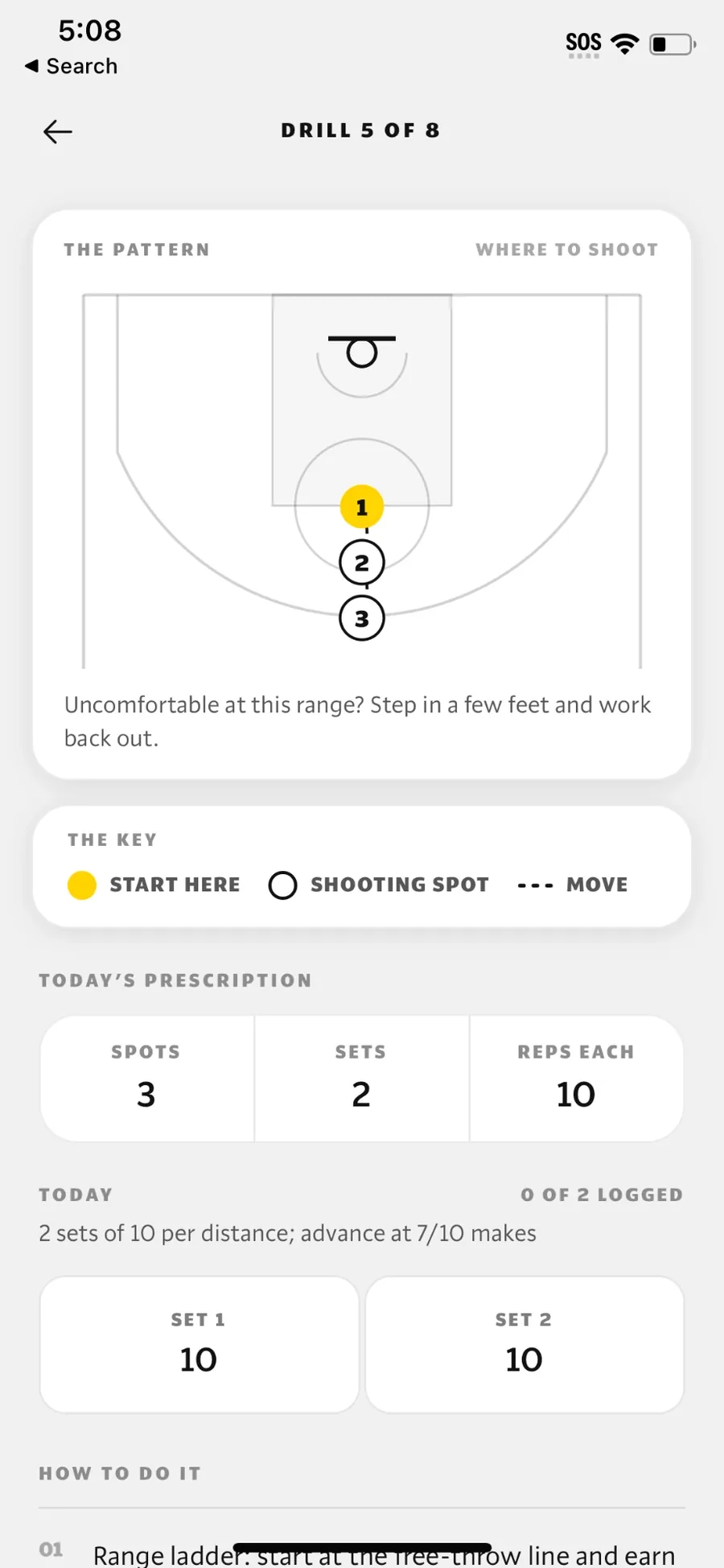
Reps alone do not make you a shooter — reps with feedback do. Score every session, drill your actual faults, and watch the rating move as the habit changes.
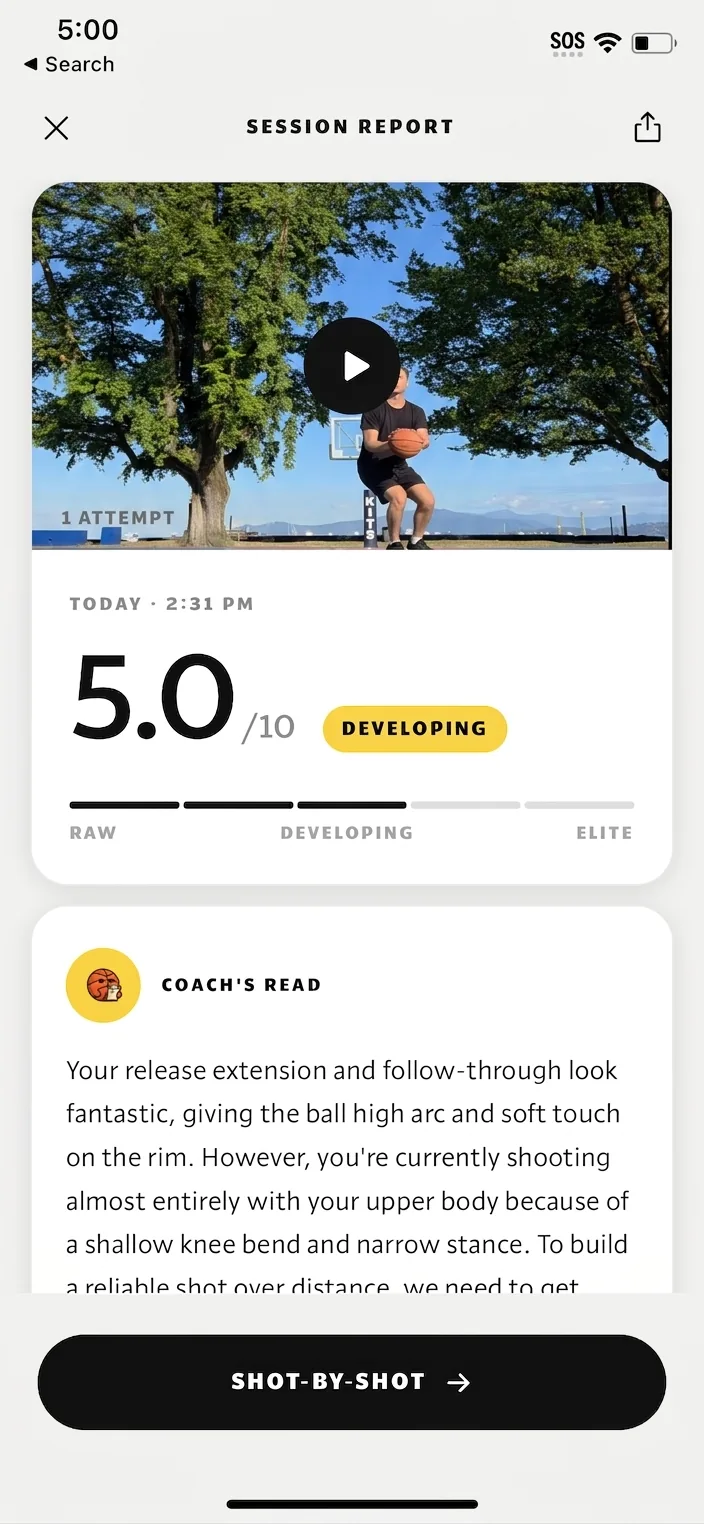
Record, review, adjust, repeat. Watch the loop that turns a practice hour into measurable progress.
How AI-guided training compares to paid coaching and to following along with videos.
"I tried a couple of AI basketball training apps already but never really liked the feedback they gave — this one actually provided a detailed analysis that could help someone."
"I've been trying to fix my release for months watching YouTube. 5 minutes with this app and it told me exactly what was wrong — my guide hand was pushing the ball."
Marcus T. · Rec League Player "As a coach, I use this with my players between sessions. They get feedback even when I'm not there. It's like giving them homework that actually helps."
Coach Davis · AAU Coach "My dad can't afford a shooting coach for me. This app gives me the same type of feedback. My percentage went from 32% to 41% in two months."
Jordan K. · 8th Grade Player A score, the reps behind it, the mechanics reviewed, and a plan for the next session.
How to structure sessions, how often to train, and how long changes take to hold.
AI basketball training is a training loop where every session is filmed and scored: the app analyzes your reps, identifies the mechanical fault costing you the most, prescribes drills for it, and then measures whether the next session improved.
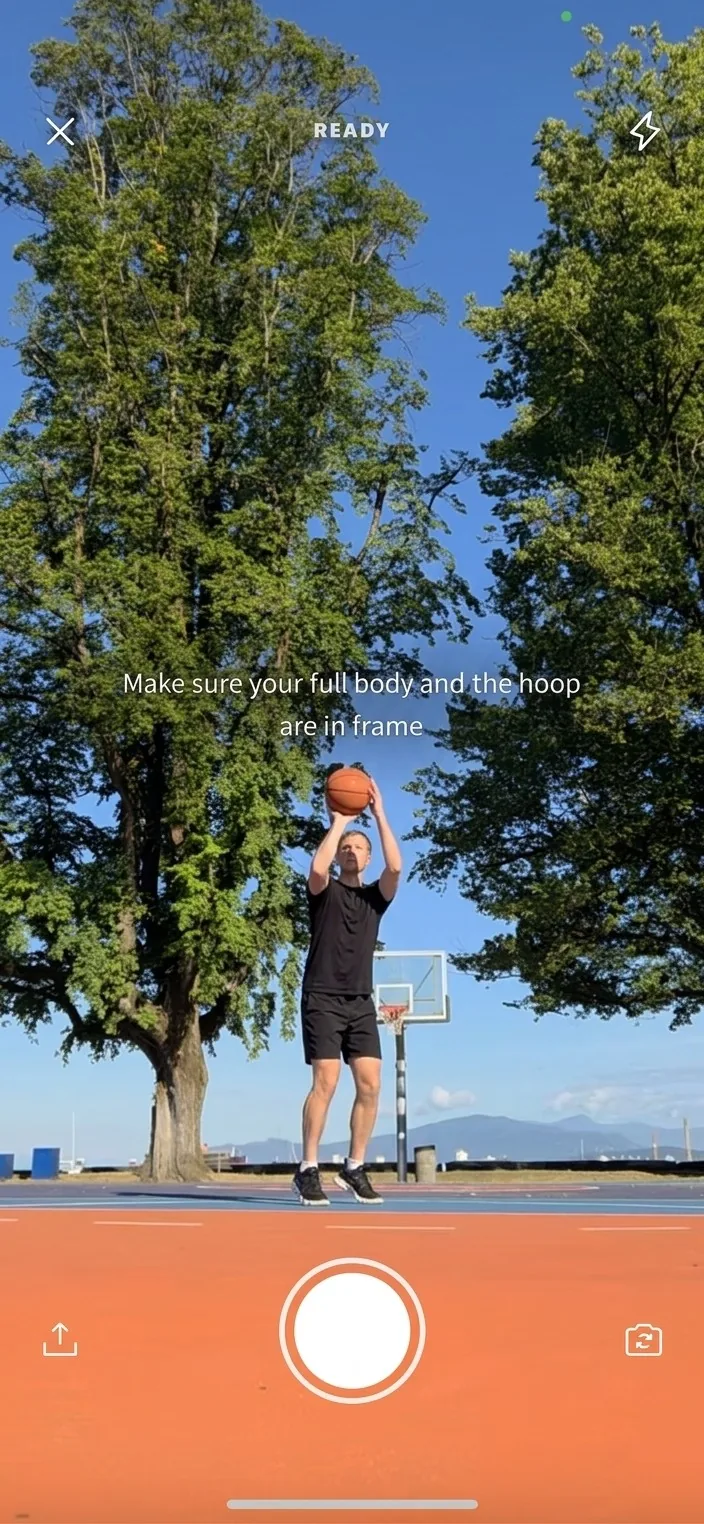
Warm up, film 25 to 40 shots at a distance you can repeat cleanly, read the breakdown, then spend the rest of the session on the one drill it prioritizes. Filming at the start gives you an honest baseline before fatigue changes your form.
Three or four shooting sessions a week works well, with one or two of them filmed and analyzed. Analyzing every session tends to produce noise, because mechanical change is slower than day-to-day variation.
Expect a few hundred deliberate reps before a change holds under speed, and longer before it holds under fatigue or contest. Players who fix one thing at a time usually see their rating move within a few weeks.
It gives you drills chosen for the faults it found in your session, so you always leave knowing what to practice. You can of course fold them into whatever workout you already run.
Yes. The analysis is about mechanics, so form shooting close to the rim — or even against a wall in a garage — still produces a usable read on your base, elbow, release and follow-through.
Repetition is the foundation of shooting, and it is also the reason so many players stop improving. Every rep you take strengthens the pattern you are already running, which is excellent news if your mechanics are sound and a serious problem if they are not. A thousand shots a week with a flared elbow does not fix the elbow; it laminates it. This is why training volume and training progress come apart so often, and why the players who improve fastest are usually the ones getting feedback, not the ones getting the most shots up.
AI basketball training closes that loop without adding anyone to your schedule, which is effectively having an AI basketball coach at every session. You film a portion of the session, the analysis scores each rep against shooting fundamentals, and you get back the one fault doing the most damage along with drills that isolate it. The session then has a purpose beyond volume: you are not shooting three hundred shots, you are working one specific change through enough reps for it to hold. That is how motor learning actually works, and it is far easier to sustain when you can see whether it is landing.
The measurement side is what keeps training honest over months. Because every filmed session is scored the same way and charted over 90 days, six months, a year or your whole history, you find out whether the block of work you committed to did anything. Sometimes it did not — the drill was wrong, or the change never survived fatigue — and knowing that after three weeks instead of a season is enormously valuable. Training without measurement means you are always arguing from feel, and feel is the least reliable instrument a shooter has — which is the argument for running an AI basketball shot tracker alongside your workouts.
None of this requires a facility, a trainer, or equipment beyond a phone. A driveway hoop, a propped-up handset and twenty-five honest reps produce a report you can train from that night, with full AI basketball analysis of the session behind it. For players whose access to real coaching is limited by cost or geography — which is most players — that is the difference between guessing at their own shot and actually working on it.
Download Jumpshot AI and make your next session the first one that gets measured.
Free to download • Available on iPhone and Android • Start improving today